Warm Homes Nest
Warm Homes Nest and solar panels in North Wales
Warm Homes Nest is the one scheme in Wales that can put solar panels on a home at no cost to the household. It's means-tested, run nationally, and works in a particular way: the Nest team decides what each home needs.
In brief
Nest is the Welsh Government's scheme for households in fuel poverty. Eligible owners and private tenants can get an improvement package at no cost, designed for their home, which can include rooftop solar. You qualify through the benefit route or the health route; the Nest team assesses the home and its Wales-based installers do the work.
Checked at source on 3 November 2026 · An independent guide from SEO-DONS LTD, not the Welsh Government, Nest or a council
What it is
Advice for everyone, packages for some
Nest does two things. It gives energy-saving advice, which the Welsh Government describes as free, impartial and available to all households in Wales; between April 2024 and March 2025 it advised 8,434 households. And it provides home energy improvement packages, at no cost, to households that meet its eligibility criteria.
The packages are what most people mean by a Nest grant, and for lower-income households they are where solar funding in Wales comes from. Each is designed for the individual property, so there is no standard set of measures. The annual report lists boilers and central heating, loft and wall insulation, solar panels and air source heat pumps among the things fitted. A network of Wales-based installers carries out the work, managed by the Nest team.
Nest also makes referrals to other help. Nearly half of its 1,028 referrals in 2024 to 2025 were to the Priority Services Register, and around 44% were benefit entitlement checks.
Solar in Nest packages
How often solar is part of it
Between October 2024 and March 2025, the first months of the new scheme, Nest installed packages in 348 households. Solar and other renewable energy measures made up 26% of installations. Heating systems, mostly boiler replacements, were the largest group at around 31%. Air source heat pumps with their hot water cylinders were about 2%.
The figures suggest solar is a regular part of Nest packages, usually alongside other work rather than on its own. Most homes helped were mid-terrace or semi-detached, together over 65% of installations, and 97% had a boiler as their main heating.
Because each package is designed for the property, Nest may recommend insulation or heating improvements before or instead of solar. That's a judgement about what will cut the household's bills most, not a refusal. For a home heated by oil or LPG, it may include a heat pump; see oil and LPG homes.
North Wales
Nest's modelled savings in the six areas
| Council area | Standard route | Crisis route |
|---|---|---|
| Isle of Anglesey | £687 | £819 |
| Gwynedd | £473 | £404 |
| Conwy | £513 | £643 |
| Denbighshire | £549 | £623 |
| Flintshire | £509 | £622 |
| Wrexham | £442 | £395 |
| Wales | £570 | £578 |
Welsh Government figures from Nest management reports. They are averages of modelled savings across the homes helped in each area, not a forecast for any one home. Each area's housing and heating figures are on North Wales council areas.
Who it's for
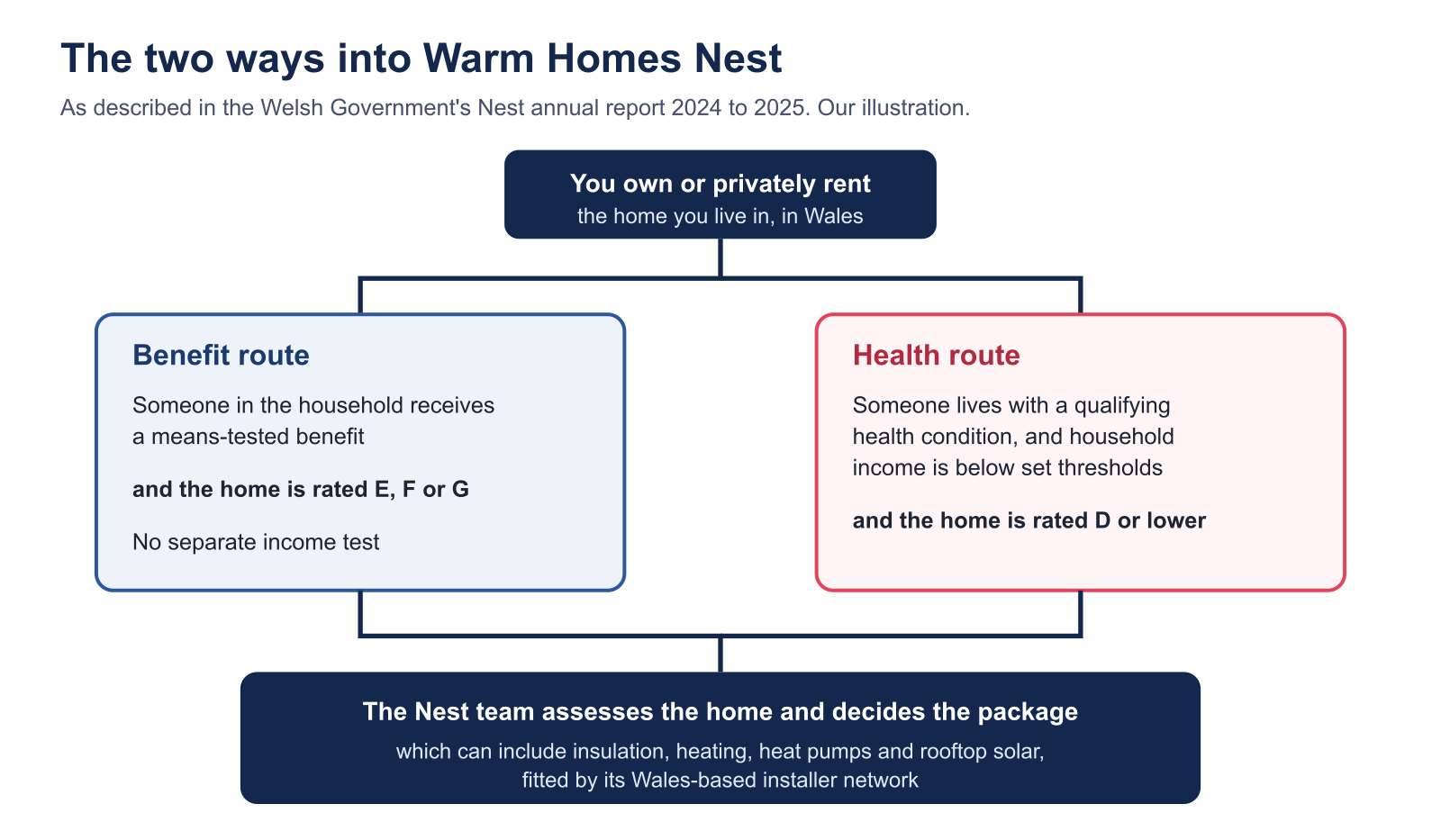
The two routes, briefly
The benefit route: someone in the household receives a means-tested benefit, and the home, owned or privately rented, has an energy rating of E, F or G.
The health route: someone in the household lives with a qualifying health condition, household income is below defined thresholds, and the home is rated D or lower (a SAP score of 68 or lower). The Welsh Government lists respiratory and circulatory diseases, mental health conditions, dementia, and intellectual and developmental disorders among the qualifying conditions.
Social housing isn't covered: homes owned by councils and housing associations are improved through their landlords. See who Nest is for for the detail.
What to expect
From first contact to finished work
- Contact Nest, directly or through a referral from an organisation such as a health board or charity.
- Eligibility checks on benefits, health, income and the home's energy rating.
- A home assessment to decide which measures suit the property.
- A package agreed with you, at no cost if you're eligible.
- Installation by Nest's Wales-based installers.
No genuine Nest contact will ask you to pay a fee or sign a loan. If anyone claiming to be from Nest does, stop and contact Nest yourself using details from gov.wales.
Urgent
If you have no heating or hot water
Nest has a crisis route for eligible households without heating or hot water, introduced in the new scheme. In its first months it supported 222 households urgently, restoring heating and hot water. If that's your situation, say so straight away when you contact Nest. See the crisis route.
Common questions
What Nest won't do
Nest won't give you money to spend with an installer you choose, fund work already done, or pay for solar on a home that doesn't meet its routes. It isn't a loan, and it doesn't cover social housing. Those limits are what make it a targeted scheme, and they're also why offers promising "Nest-funded solar for everyone" should be treated with suspicion.
After installation
Using the panels well
Solar fitted through Nest works like any other system: it lowers bills most when you use electricity during the day. Ask the installer at handover how to read the inverter and what maintenance it needs. If your supplier offers an export tariff under the SEG, you may be able to earn from surplus electricity, provided the installation is certified and exports are metered. See export payments.
Nest questions
Does Nest install solar panels?
It can. Packages are designed for each home and can include rooftop solar, as well as heating, insulation and heat pumps. Solar and other renewables made up 26% of installations between October 2024 and March 2025.
Do I pay anything?
Nest provides improvement packages at no cost to eligible households, according to the Welsh Government.
Can I choose my installer?
No. The work is carried out by a network of Wales-based installers managed by the Nest team.
Can I ask Nest for solar only?
You can tell Nest what you’re interested in, but the Nest team decides the package after assessing the home, so it may recommend other measures first.
Does Nest give advice to people who aren’t eligible?
Yes. The Welsh Government describes Nest’s advice service as free and impartial and available to all households in Wales.
Practicalities
Getting ready for a Nest assessment
Have evidence of any means-tested benefit to hand, and details of any health condition if you’re applying on the health route, along with a rough idea of household income. If the home has an energy performance certificate, note its rating and date.
The assessment looks at the whole home: insulation, heating, windows and roof. Be ready to show the assessor the loft, the boiler and the electricity meter. If you rent privately, let your landlord know Nest may be in touch, since their agreement will be needed for any work.
Afterwards
If Nest says no, or not now
If the household doesn’t meet a route, Nest can still offer advice, and it refers people to other help, including benefit entitlement checks, which were around 44% of its referrals in 2024 to 2025. A benefit you’re entitled to but not claiming could change your eligibility.
If a package doesn’t include solar, ask why. The answer, perhaps that insulation or heating will cut bills more, is useful in itself, and it tells you what to prioritise if you later pay for improvements privately.
One scheme, all of Wales
Nest across the six areas
Nest's rules are the same in every North Wales council area, from Holyhead to Chirk. What varies is the homes: far more are heated by oil or LPG in the west, which shapes what a package might contain. The modelled savings by area in the table above reflect those differences, not different rules.
Checked against
- Warm Homes Nest scheme annual report 2024 to 2025 (Welsh Government), read 3 November 2026
- Find an energy certificate (England and Wales) (GOV.UK), read 3 November 2026
- SEG guidance for generators (PDF) (Ofgem), read 2 November 2026
- find a certified installer (MCS), read 3 November 2026
Not sure which scheme, if any, fits your home?
Tell us which council area you're in and what you're looking into. Your message reaches SEO-DONS LTD, the publisher of this guide, and we answer by email. We're not a scheme and can't approve anything, but we can point you to the right one.
What happens next
- Your message reaches SEO-DONS LTD, which publishes this guide.
- We reply by email with the scheme page that fits, if there is one.
- Any application is between you and that scheme.